What industries use precision glass microfabrication?
Step into a world where precision meets possibility. At FEMTOPRINT, we unlock the full potential of glass microfabrication to empower next-generation systems across the most demanding high-tech domains.
For over a decade of innovation, we’ve been at the cutting edge of designing and manufacturing advanced microdevices—from microfluidic platforms and integrated photonic circuits to quantum components, MEMS architectures, and custom optical elements. All seamlessly packaged through our unique expertise in monolithic glass processing and hermetic encapsulation.
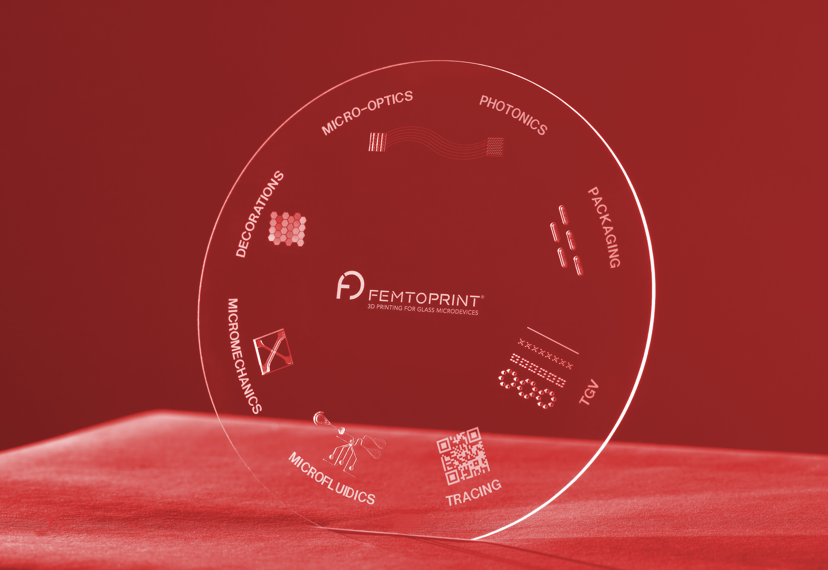
Our strength lies in our interdisciplinary approach: blending physics, engineering, and material science to co-develop systems with enhanced performance, scalability, and functional integration. Whether you're prototyping disruptive medical technologies, building scalable quantum systems, or developing high-precision optical sensors—FEMTOPRINT stands as your strategic partner in micro-innovation.
Explore a curated selection of the components, devices, and systems we've helped bring to life—each shaped by our commitment to ultrafast laser precision, application-driven design, and wafer-level scalability.
How is glass microfabrication used in Life Sciences and diagnostics?
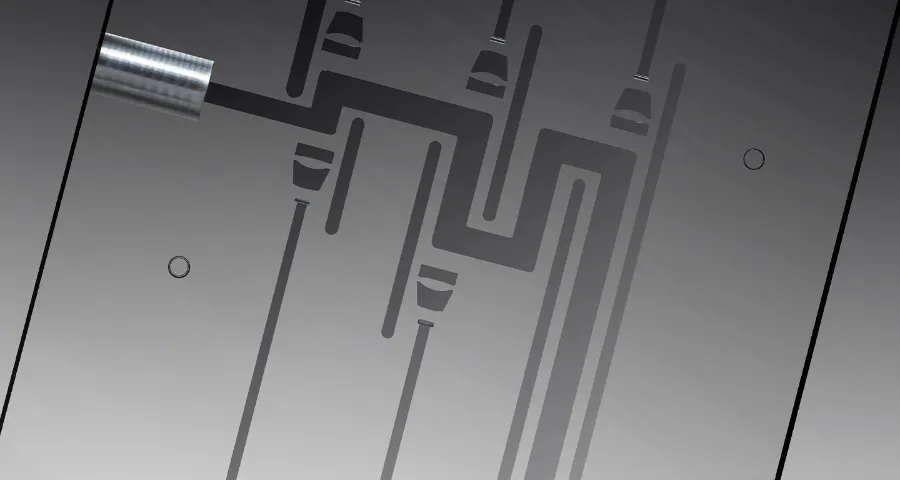
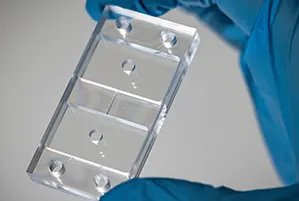
Glass microfabrication creates microfluidic lab-on-a-chip platforms, single-cell analysis channels, and custom glass masters. Femtosecond laser precision allows sub-10 micron channel widths with zero dead volume, optimizing flow dynamics for drug discovery and automated diagnostic workflows.
What medical device applications require glass microfabrication?
Medical applications include active implantable devices (AIMDs), biocompatible MEMS, and micro-needles. Fused silica glass delivers zero outgassing, extreme chemical inertness, and ultra-smooth finishes (Ra < 10 nm) with tight sub-micron tolerances (+/- 1 micron) for precise surgical tooling.
What optical applications benefit from femtosecond laser glass microfabrication?
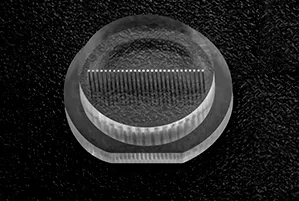
Optical applications benefit through maskless 3D manufacturing of freeform micro-optics, diffractive optical elements (DOEs), and glass interposers. It eliminates lithography restrictions, providing maximum thermal stability and absolute transmission from deep UV to near-IR wavelengths.
How does glass microfabrication enable integrated photonics and fiber optics?
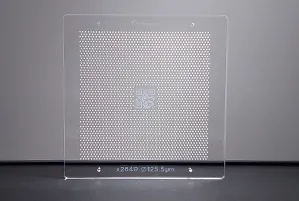
It enables integrated photonics by writing low-loss 3D optical waveguides directly within bulk glass. This process manufactures high-density fiber ferrules, hole arrays, and alignment matrices with sub-micron pitch control, minimizing insertion loss for co-packaged optics (CPO) and AI hardware infrastructure.
What quantum technology components does FEMTOPRINT manufacture in glass?
FEMTOPRINT manufactures monolithic glass substrates for Paul and Penning ion traps, 3D atom traps, and quantum sensing hardware. These feature high-aspect-ratio metallization and Through-Glass Vias (TGVs), meeting strict Ultra-High Vacuum (UHV) and electromagnetic isolation criteria
How does FEMTOPRINT serve the Swiss watchmaking and luxury industry?
We supply the luxury watchmaking market with ultra-light micromechanical components, skeletonized main plates, bridges, multi-level 3D watch dials, and date discs. Machining fused silica and sapphire ensures extreme geometric tolerances and high-contrast micro-engravings.
What space and aerospace applications use FEMTOPRINT glass components?
Aerospace systems utilize glass micro-components for extreme-environment sensors, micro-thruster nozzles, and ruggedized optical interconnects. 3D laser-etched fused silica ensures high mechanical resistance against cosmic radiation, severe thermal cycling, and heavy launch vibrations.
How does FEMTOPRINT support university research and R&D institutions?
FEMTOPRINT provides fast-turnaround rapid prototyping, contract manufacturing, and collaborative R&D frameworks. By eliminating complex tooling costs, we enable researchers to instantly validate functional 3D microfluidic chips, MEMS, and photonic integrated circuits (PICs) with industrial scalability.
TALK to our experts and discover more.