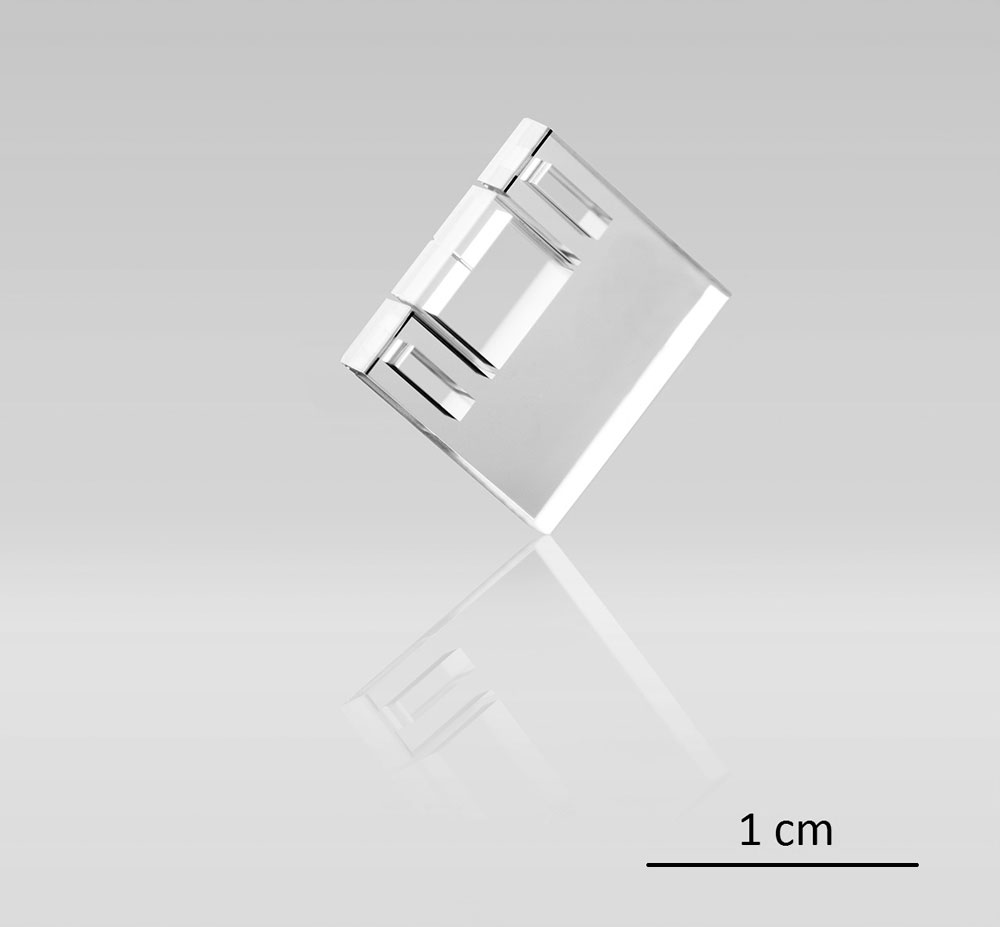
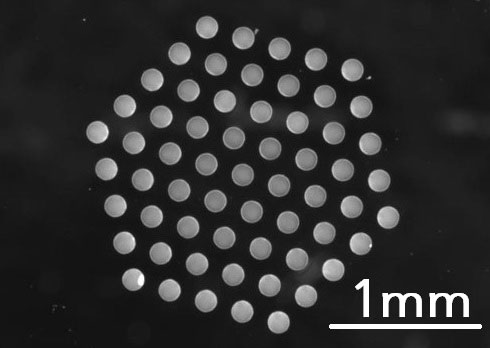
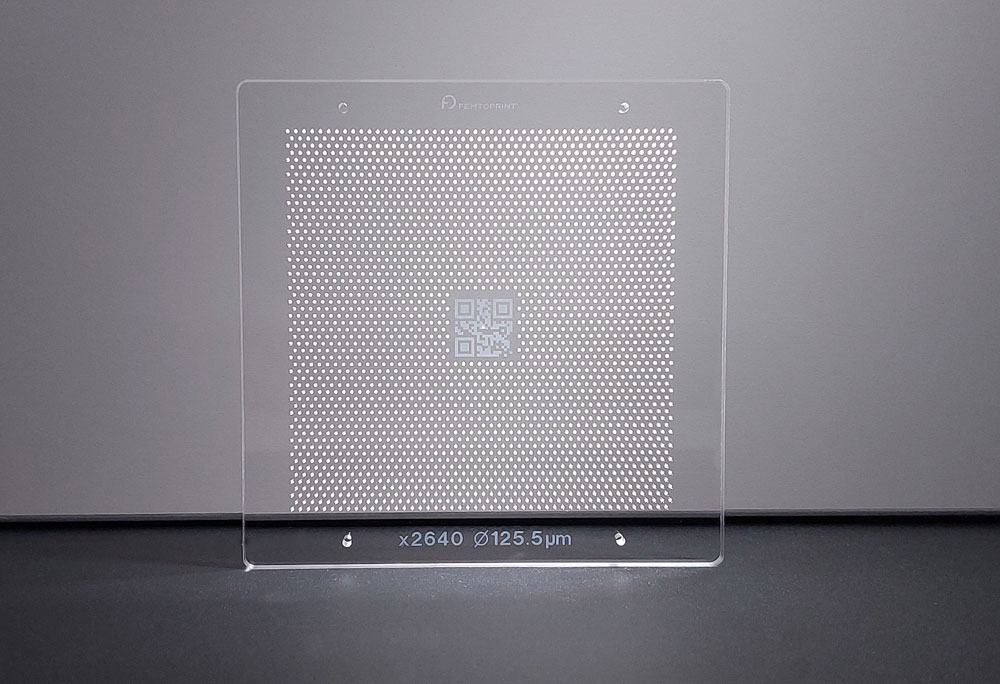
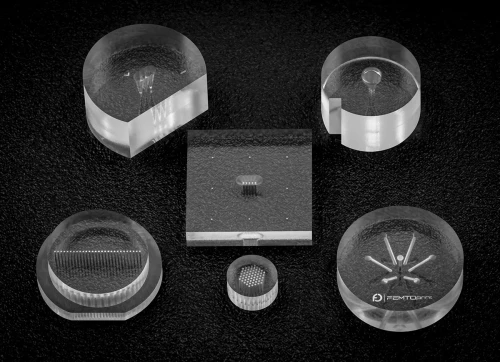
Micro-optics are optical components with features between roughly 1 µm and 1 mm, microlenses, microlens arrays, and freeform micro-optical elements. FEMTOPRINT fabricates them directly in glass using femtosecond-laser machining: a maskless, direct-write process that produces true 3D freeform surfaces and monolithic integration with waveguides and fibre connectivity inside a single substrate, something replication-based methods such as photoresist reflow or soft lithography cannot do.
For more than a decade we have supplied glass micro-optical components and replication masters to OEMs in photonics, sensing, AR/VR and life sciences, scaling from a first prototype to wafer-level production under ISO 13485 and ISO 9001.
Most micro-optics are produced by replication or lithographic methods: photoresist reflow forms spherical microlenses from melted resist; soft lithography transfers a pattern from a master; and direct laser writing builds surface relief in a photosensitive layer. These methods are mature and cost-effective for surface-only, largely spherical geometries, but they are constrained to 2D or 2.5D profiles and rarely integrate optical functions into the bulk of the substrate.
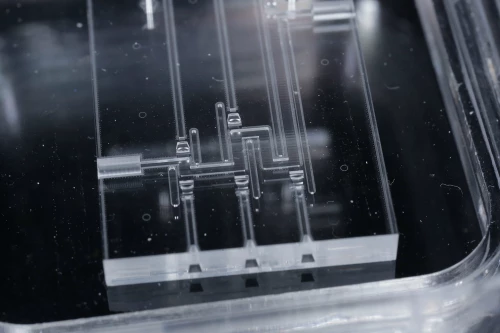
FEMTOPRINT uses femtosecond-laser machining (Selective Laser Etching, SLE) to write geometry directly inside and onto fused silica and borosilicate glass. Because it is maskless and three-dimensional, it produces true freeform surfaces and lets a single monolithic part combine a lens, a buried waveguide and a fibre-alignment feature — removing assembly and alignment steps downstream.
|
Capability |
Femtosecond SLE (FEMTOPRINT) |
Photoresist reflow |
Soft lithography |
Direct laser writing |
|
Geometry |
True 3D freeform |
Spherical, surface only |
Replica of a master |
Surface relief |
|
Maskless / direct-write |
Yes |
No |
No |
Yes |
Fused silica and borosilicate, including Borofloat® 33, optical-grade substrates chosen for transparency across the UV–IR range, thermal and chemical stability, and low optical scatter. Application-specific glasses are defined per project after a feasibility review.
We supply glass micro-optics and replication masters across:
The same platform that builds a functional optic also writes the master. We deliver high-fidelity glass masters and tooling for imprint lithography and injection moulding, so a design validated as a FEMTOPRINT prototype can move into high-volume replication without redesign and, where wafer-level glass production fits, we scale directly on substrates up to 300 mm.
Talk to our experts about your micro-optics project.
Micro-optics have features between roughly 1 µm and 1 mm, microlenses, arrays and freeform elements and need fabrication and metrology methods adapted to that scale, unlike classical bulk optics.
Yes. Femtosecond-laser machining is a maskless 3D process, so it produces true freeform surfaces that reflow or replication methods cannot, including elements integrated with waveguides in the same glass part.
Optical surface roughness Sa below 10 nm after post-treatment, micron-level form accuracy (XY to ±1 µm, Z to ±2 µm), with feature sizes from tens to hundreds of micrometres.
Fused silica and borosilicate, including Borofloat® 33. Application-specific substrates are defined per project after a feasibility review.
Yes. We fabricate high-fidelity glass masters and tools for imprint lithography and injection moulding, bridging prototyping and high-volume manufacturing.
Yes. Rapid prototyping with design-for-manufacturing support, scaling to wafer-level production up to 300 mm under ISO 13485 and ISO 9001.
Related optics applications: Discover more femtosecond laser glass micromachining solutions for optics, including Miniaturized Optics and Micro-Optical Elements.
 Monolithic integration with other optical functionalities such as waveguiding and fibre connectivity.
Fully 3D free-form fabrication.
Micro-optical elements with feature sizes from 10’s um up to 100’s um.
Optical surface quality with average roughness < 10nm.
Micron-precision shape accuracy.
Rapid prototyping, including design for manufacturing.
Production of masters & tools for imprint/injection moulding.
Monolithic integration with other optical functionalities such as waveguiding and fibre connectivity.
Fully 3D free-form fabrication.
Micro-optical elements with feature sizes from 10’s um up to 100’s um.
Optical surface quality with average roughness < 10nm.
Micron-precision shape accuracy.
Rapid prototyping, including design for manufacturing.
Production of masters & tools for imprint/injection moulding.