Glass microfluidic devices manufactured with FEMTOPRINT’s technology offer superior biocompatibility, complete chemical inertness, and exceptional optical clarity. These properties are essential for achieving high-precision analytical results in sensitive medical and biological applications.
Unlike polymers like PDMS or COC, glass offers significantly higher chemical resistance, zero leaching, and no swelling. It also eliminates autofluorescence and thermal deformation, making it the ideal substrate for high-resolution optical detection.
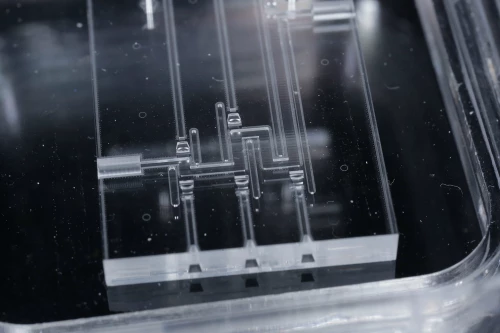
Our femtosecond laser etching process can achieve microchannels with widths as small as 30–50 µm and high aspect ratios. This precision allows for the creation of complex, high-density fluidic circuits within a monolithic glass block.
Yes. Through advanced thermal fusion and laser bonding, our glass chips are hermetically sealed and can withstand several bars of pressure, ensuring structural integrity in demanding high-pressure flow environments.
The ultra-smooth surfaces and chemical stability of glass minimize sample contamination and non-specific adsorption. This leads to significantly enhanced assay reproducibility and higher sensitivity in diagnostic tests.
Absolutely. Glass’s total chemical inertness and superior optical access make it perfect for live cell observation and the creation of stable micro-environments for organ-on-chip simulations.
Thermal fusion and laser bonding are the preferred methods. They provide strong, molecular-level, leak-free seals that are fully compatible with biological fluids without the need for potentially contaminating adhesives.
Yes. Our technology enables the bonding of glass with various materials, such as silicon, to create hybrid microsystems. This is achieved via thermal or laser-assisted processes that maintain seal integrity.
Our process allows for true 3D design freedom, including overlapping channels, buried optics, and complex 3D manifolds, all integrated without the alignment issues typical of layered fabrication.
Yes. One of the primary advantages of glass is its durability. Glass chips can be cleaned and sterilized multiple times without degradation, offering a sustainable and cost-effective alternative to disposable plastic chips.
Glass chips provide high transparency and extremely low autofluorescence. Furthermore, our platform allows for the direct embedding of optical or photonic miniaturized components, enabling seamless integration with microscopy and spectroscopy.
We primarily utilize high-purity Fused Silica and Borosilicate glass. These materials are selected for their exceptional chemical purity, thermal stability, and consistent processing results.
FEMTOPRINT’s maskless micromanufacturing allows for rapid prototyping. We can generally deliver initial functional samples in under 5 weeks, ensuring a fast response to any necessary design iterations.
Yes. The rigidity of glass ensures that channel geometries remain constant even under high pressure. Combined with sub-micron precision and smooth walls, this guarantees highly reproducible laminar flow regimes.
Our platform is designed for industrial scalability. We guarantee an elevated degree of reproducibility across batches, ensuring that a design prototyped in our lab can be scaled to high-volume industrial production.
Have a specific question? Contact our expert Team
Explore our Life Sciences applications: Diagnostics, Cell Therapies, and Single Cell Analysis.