Glass waveguides and related beam routing, splitting, and coupling devices
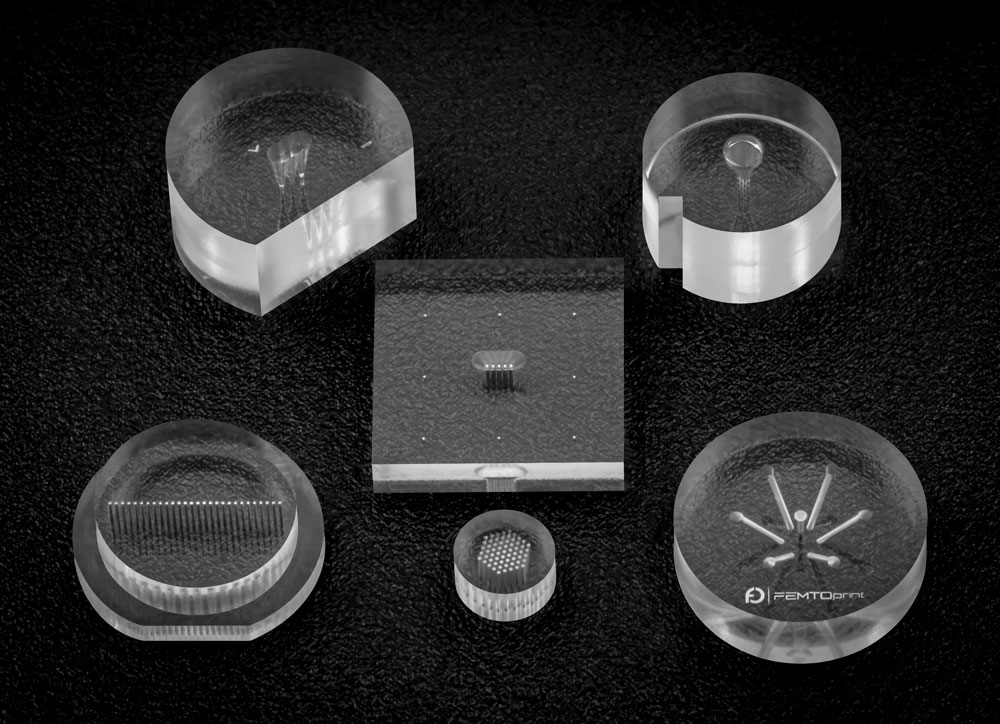
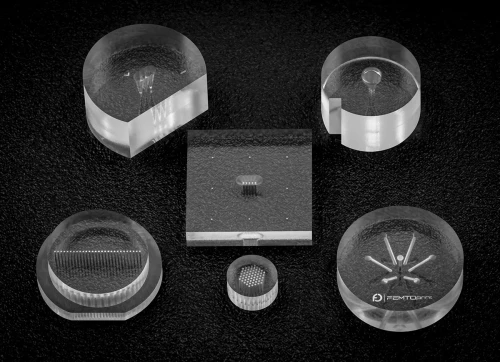
As photonic systems become more complex, traditional fabrication techniques often fall short in flexibility and integration. FEMTOPRINT’s platform enables the direct writing of 3D glass waveguides for beam routing, splitting, and coupling, offering true volumetric freedom.
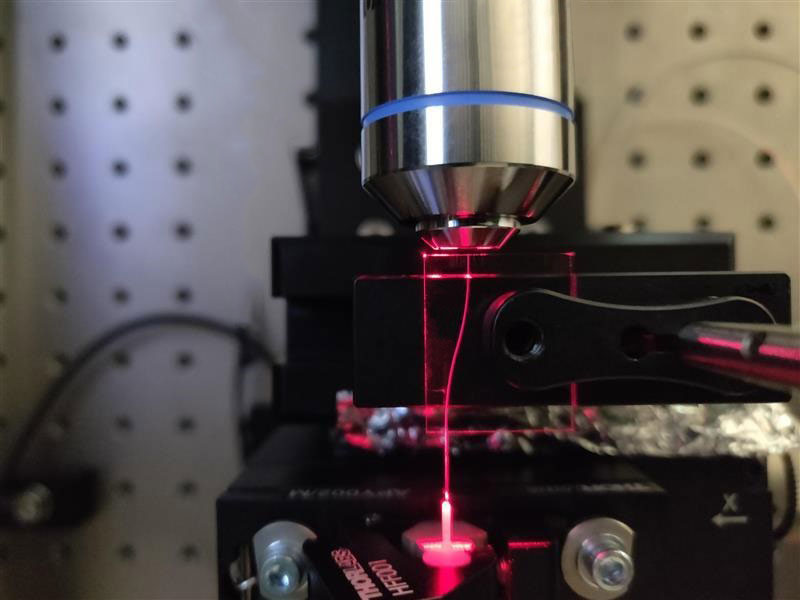
Using ultrafast laser pulses, we can write refractive index-modulated patterns directly within fused silica or borosilicate glass wafers—ideal for light coupling, beam steering, or multi-channel routing.
Our approach allows:
%20(1).png)
Whether you are building a PIC, a quantum device, or a fiber array interface, our laser-written waveguides provide the precision and flexibility that other solutions cannot match.
FEMTOPRINT’s advanced laser micro-machining technology enables localized refractive index modification in glass, achieving changes in the range of 10⁻² to 10⁻³.
This capability is essential for the fabrication of embedded 3D optical waveguides within the bulk of transparent substrates, unlocking new opportunities in the design and integration of photonic integrated circuits (PICs) and optical interconnects.
With this laser-based process, it is possible to precisely manufacture both single-mode and multimode optical waveguides at key telecommunications wavelengths, specifically 1310 nm and 1550 nm. Additional optical components—such as tapered waveguides, mode converters, fan-in/fan-out structures, and more—can also be seamlessly integrated, supporting the development of compact, high-performance photonic devices for next-generation applications.
Discover more about biophotonics here
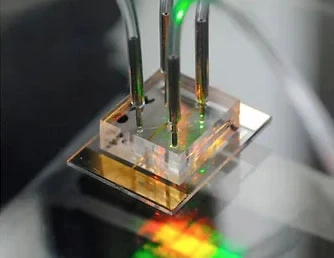
A refractive-index pattern written inside the bulk of glass with a femtosecond laser, guiding light along a defined path. Because the writing is volumetric, the waveguides route, split and couple light in true 3D, not just in one plane.
Single-mode and multimode waveguides at the telecom wavelengths 1310 nm and 1550 nm, with guiding across a broad range from the visible to the infrared.
Yes. Spot-size converters tailor the mode-field diameter for low-loss matching into PICs or fibers; fan-in/fan-out structures, directional couplers and MMIs handle routing; micro-optics and alignment features integrate monolithically in the same glass.
Fused silica, Borofloat 33 and Eagle XG, written directly by ultrafast laser pulses with no masks.
They allow multi-layer 3D routing and monolithic integration of waveguides with micro-optics and alignment features, reducing assembly and supporting the dense fiber-to-chip interconnects co-packaged optics needs.
 Wavelenght range 650-1550nm.
Min mode field diameter 6-8um at 1000nm-1550nm, respectively
Propagation losses <0.2dB/cm.
Min bending radious 20-25mm at 1000nm-1550nm.
Materials: fused silica, borofloat 33, Eagle XG.
Wavelenght range 650-1550nm.
Min mode field diameter 6-8um at 1000nm-1550nm, respectively
Propagation losses <0.2dB/cm.
Min bending radious 20-25mm at 1000nm-1550nm.
Materials: fused silica, borofloat 33, Eagle XG.