FEMTOPRINT provides advanced glass encapsulation solutions for microfluidic devices, implantable medical systems and photonic applications. Our proprietary manufacturing process enables hermetic sealing, optical transparency and biocompatibility.
Medical implants must be hermetically sealed to safeguard internal electronics while maintaining long-term biocompatibility. Traditional encapsulation methods often struggle with durability, miniaturization, and resistance to biological environments. Glass encapsulation is revolutionizing implant design by providing unmatched protection, precision, and performance.
At FEMTOPRINT, we specialize in customized, miniaturized glass encapsulation solutions tailored for neuromodulation, ophthalmology, and drug delivery applications. Our advanced glass microfabrication technology ensures superior reliability, biocompatibility, and precision for implantable medical devices.
Glass encapsulation hermetically seals electronics, sensors or microfluidics inside a biocompatible glass package. A femtosecond-laser process bonds glass-to-glass or glass-to-silicon at room temperature, with no adhesives, protecting heat-sensitive components while the package stays transparent to light and radio frequency. It suits long-term implantable medical devices where a metal can would be too bulky or would block signals.
An implant has to protect its internal electronics for years inside an aggressive biological environment and do it in a shrinking footprint. Glass earns its place there for a few concrete reasons: it is biocompatible and chemically stable, resistant to corrosion, moisture, and abrasion; electrically insulating; neutral to magnetic fields; and transparent to both optical and radio-frequency signals. That last property is the one designers underrate, because RF and light pass through glass, the package can carry wireless data and power without the feedthroughs a titanium can needs, which cuts bulk and a common failure point.
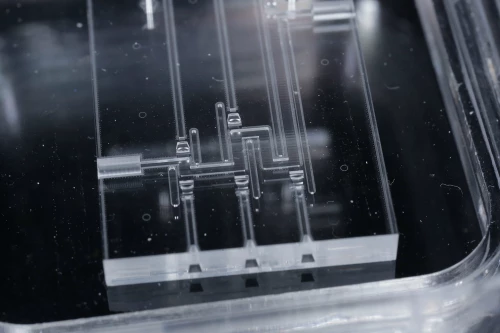
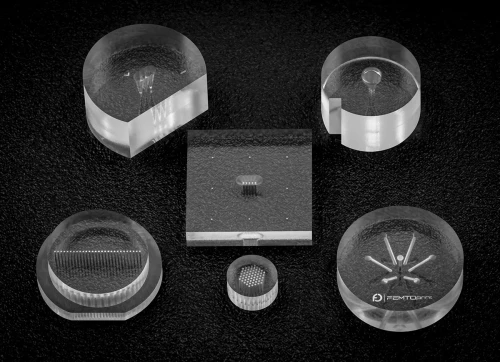
The seal is formed by a localized femtosecond-laser weld, so the bond happens without heating the whole assembly. Heat-sensitive electronics and sensors survive the process intact. It is adhesive-free, which removes outgassing and the long-term biocompatibility questions that organic adhesives raise, and it works down to sub-millimetre encapsulation. Because the geometry is written from a digital file, optical, photonic, mechanical and fluidic functions can be integrated into a single monolithic glass body rather than assembled from bonded parts.
Process capabilities: XY ±1 µm / Z ±2 µm tolerances, ~1 µm resolution, proven hermeticity for liquids and gases. Substrates: fused silica and borosilicate. Leak-tightness targets and qualification are defined per application through a feasibility review.
The same process that builds the first prototype runs through to certified volume production in Switzerland, under ISO 13485 and ISO 9001, so the tolerances and finish you qualify on a sample are the tolerances you get at scale. Vertical integration keeps materials sourcing, laser writing, sealing, metrology and final QC under one roof, which is what makes the traceability real rather than reconstructed from several suppliers' records.
TALK WITH OUR EXPERTS
It is the hermetic sealing of electronics, sensors or microfluidics inside a biocompatible glass package. A femtosecond-laser process bonds glass-to-glass or glass-to-silicon at room temperature with no adhesives, protecting the components for long-term implantation.
The seal is a localized femtosecond-laser weld at room temperature, so heat-sensitive electronics are never exposed to high-temperature bonding. The process is adhesive-free, which avoids outgassing and preserves device function.
Yes. Glass is biocompatible, chemically stable and resistant to corrosion, moisture and abrasion, which supports long-term use inside the body. FEMTOPRINT operates under ISO 13485 and ISO 9001.
In many designs, yes. Glass is transparent to light and radio frequency, so it can pass wireless data and power through the package and reduce or remove feedthroughs. It is also more miniaturizable and more hypoallergenic than metal.
Yes. The same process runs from rapid prototyping to certified volume production in Switzerland, holding XY ±1 µm / Z ±2 µm tolerances under ISO 13485 and ISO 9001.
 Medical implants
Electronic packaging
Neuromodulation devices
Ophthalmic devices
Bio-sensors
Pressure sensors
Solid experience in laser encapsulation’s processes in several application domains.
Monolithic integration of optical, photonic, mechanical and fluidic functionalities in glass packaging.
Proven hermeticity for liquids and gases.
Glass-to-glass / glass-to-silicon sealing process at room temperature. This helps to preserve the functionalities of encapsulated electronics and micro-electronics devices.
Adhesive-free, biocompatible, working even at sub-mm size encapsulation.
Medical implants
Electronic packaging
Neuromodulation devices
Ophthalmic devices
Bio-sensors
Pressure sensors
Solid experience in laser encapsulation’s processes in several application domains.
Monolithic integration of optical, photonic, mechanical and fluidic functionalities in glass packaging.
Proven hermeticity for liquids and gases.
Glass-to-glass / glass-to-silicon sealing process at room temperature. This helps to preserve the functionalities of encapsulated electronics and micro-electronics devices.
Adhesive-free, biocompatible, working even at sub-mm size encapsulation.