Glass is inherently biocompatible, chemically resistant, and offers a low MRI footprint. These properties make it the perfect material for high-performance medical-grade components that must interact safely with the human body or sensitive diagnostic reagents.
In highly miniaturized devices, such as implantables, brittleness is rarely a limiting factor. Furthermore, glass components can be specially coated or encased to provide additional structural protection and enhanced durability.
Yes. Our glass microfabrication processes are fully compliant with ISO 13485 standards, ensuring that our manufacturing and quality management systems meet the rigorous requirements for medical device production.
Absolutely. Glass can be hermetically bonded with materials like silicon, which is often the substrate of choice for electronics deposition and advanced sensing integration in medical microsystems.
Yes. Glass is inert, non-toxic, and highly biocompatible. Its stability ensures that it does not degrade or leach substances into the body, making it a gold standard for long-term implantable applications.
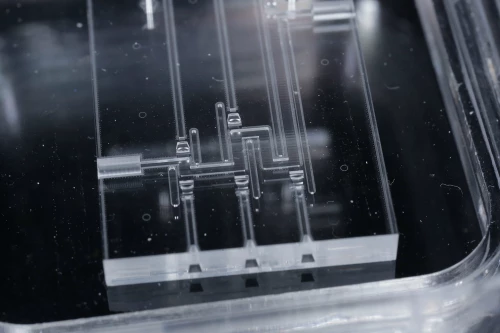
Yes. Our femtosecond laser machining enables the precise integration of cavities, vias, and microchannels, which are essential for the advanced packaging of medical sensors and Micro-Electro-Mechanical Systems (MEMS).
We offer a variety of specialized post-processing treatments that complement our core micromanufacturing technology. These treatments guarantee ultra-low surface roughness levels, essential for minimizing protein binding or optimizing fluid dynamics.
To ensure biocompatible and hermetic seals, we utilize thermal fusion, anodic bonding, and laser bonding. These techniques avoid the use of toxic glues, maintaining the purity of the medical device.
Yes. High-precision metal coatings and electrodes can be integrated directly onto or within glass structures to allow for signal routing, sensing, or active stimulation in smart medical devices.
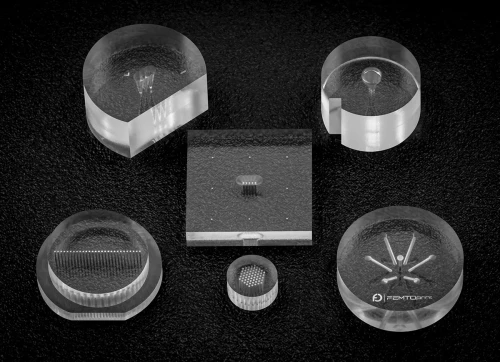
FEMTOPRINT’s selective laser etching allows for the realization of extremely complex 3D forms with micron-level precision. We can achieve tolerances down to the single micron, depending on the specific design requirements.
Our monolithic fabrication process eliminates the need for manual alignment. By forming optical, fluidic, or mechanical features within a single glass block, we ensure elevated positional accuracy and structural integrity.
Yes. While we excel at prototyping, our wafer-level fabrication scales efficiently to thousands of units per year. We provide repeatable quality, predictable cost curves, and the industrial stability required for mass-market medical devices.
Free Consultation: Is your project production-ready?
Explore our MedTech applications: Biocompatible MEMS, Diagnostics, and Drug Discovery and Therapeutics.