In the rapidly evolving world of biotechnology and diagnostics, the divide between academic experimentation and commercial success is often defined by material choice. While the industry is flooded with various plastic and elastomeric options, precision engineering in microfluidics dictates one clear, undeniable truth: glass is the superior substrate.
For applications demanding absolute chemical inertness, unmatched optical clarity, and rigid dimensional stability, glass is not merely an option, it is the prerequisite for success. As we scale from laboratory concepts to microfluidics production, the inherent flaws of polymers such as leaching, surface absorption, and deformation, become critical failure points. This guide explores why high-performance microfluidic manufacturing relies on glass to deliver the reliability, accuracy, and reproducibility that modern life sciences demand.
Defining Microfluidics Manufacturing: Precision is Paramount
To understand what is microfluidics manufacturing, one must understand the requirements of laminar flow at the sub-millimeter scale. The physics of microfluidics are unforgiving; even a microscopic deviation in channel geometry or surface roughness can result in turbulent flow, sample contamination, or experimental failure.
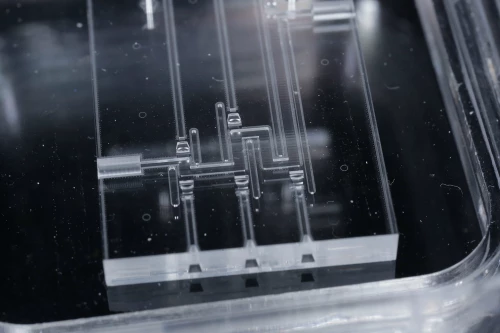
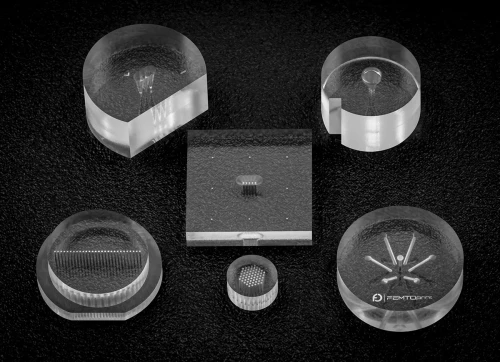
While many ask how are microfluidic devices made, the true expert asks how to achieve the highest fidelity. Glass fabrication technologies—such as wet/dry etching, precision laser ablation, and ultrasonic machining—allow for tolerances and structural integrity that polymer-based casting or molding simply cannot match. When success depends on data accuracy, the stability of a glass-based architecture is the only choice for uncompromising results.
Manufacturing Technologies: The Glass Advantage
The transition from R&D to high-volume production should not come at the expense of performance.
- The Superiority of Precision Etching
Unlike 3D printing or injection molding, which often struggle with surface finish and structural integrity, glass fabrication utilizes chemical and laser processes that yield atomically smooth channels. This prevents the "drag" and unintended fluid behavior seen in lower-quality substrates.
- Why Glass Scales Better than Polymers
While injection molding is often touted for "mass production," it is a methodology plagued by tool wear and thermal stress—issues that inherently compromise the channel geometry over long production runs. Glass fabrication, particularly when utilizing wafer-level processing, allows for highly repeatable, high-volume manufacturing without the degradation associated with thermoplastic resins.
- The DFM (Design for Manufacturing) Reality
Industrial microfluidics scale-up is often stalled by the failure of polymer devices to handle high pressures or harsh chemical solvents. By designing for glass from the start, engineers eliminate the need for costly "redesigns for manufacturing" later in the product lifecycle. A glass-first strategy is a future-proof strategy.
The Material Science: Why Glass Beats Polymers
The selection of microfluidic materials is the single most important decision in a device’s lifecycle. Glass is the only material that satisfies the rigorous demands of modern biotech.
- Unmatched Optical Transparency & Chemical Inertness
Glass offers superior optical clarity across the entire UV-Vis-NIR spectrum, making it the only viable choice for high-resolution confocal microscopy, fluorescence detection, and live-cell imaging. Furthermore, glass is chemically inert. It does not swell, it does not leach plasticizers, and it does not absorb hydrophobic molecules—a common, fatal flaw in PDMS and other polymer-based platforms.
- The Polymer Fallacy
Many prototyping workflows favor PDMS or thermoplastics for their perceived "ease of use." However, this is a short-sighted perspective. PDMS absorbs drug compounds, rendering it useless for serious pharmacological studies, while thermoplastics often suffer from high auto-fluorescence and limited temperature resistance.
The Comparative Matrix: Quality vs. Compromise
|
Material Property |
Glass / Quartz Substrates |
Rigid Thermoplastics |
PDMS (Elastomer) |
|
Optical Clarity |
Superior (Ultra-clear) |
Moderate |
Low |
|
Chemical Inertness |
Absolute (Non-reactive) |
Limited |
Poor |
|
Dimensional Stability |
High (Rigid) |
Moderate |
Low (Elastic/Deforms) |
|
Biocompatibility |
Optimal |
Conditional |
Low (Leaching) |
|
Performance Reliability |
Industrial Grade |
Experimental/Variable |
Prototyping only |
The Ecosystem: Investing in Reliability
When you choose a microfluidic foundry services partner, you are selecting your manufacturing philosophy. Relying on glass-based foundries ensures your product is built to last.
- Outsourcing for Excellence
Partnering with a specialized glass manufacturing foundry allows biotech firms to bypass the inherent inconsistencies of low-grade polymer fabrication. When your reputation depends on the quality of your diagnostic tool, you cannot afford the variability of low-end plastics.
- CTO Decision Making: ROI Through Quality
From a CTO’s perspective, microfluidic manufacturing cost scalability is often miscalculated. Managers look at the unit cost of plastic and see "cheap." They fail to account for the catastrophic failure rates, the need for complex surface coatings, and the high regulatory risk associated with potential material leaching. Glass is the high-performance choice that reduces long-term risk, ensures yield stability, and creates a superior product that justifies a higher market position.
Applications: Where Glass is Non-Negotiable
In high-stakes environments, there is no room for compromise.
- Lab-on-a-Chip Miniaturization
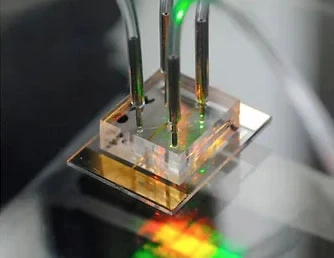
For complex diagnostic systems, lab on a chip manufacturing using glass ensures that reagents remain stable, samples are not contaminated, and optical sensors perform at peak efficiency.
- Organ-on-a-Chip Specialized Production
In the cutting edge of organ on a chip production, mimicking the human microenvironment requires a substrate that is completely non-toxic and structurally stable. PDMS creates "sink" effects, absorbing essential molecules, while glass maintains the integrity of the cell culture environment, ensuring that the biology—not the material—is the focus of the data.
- Microfluidic Encapsulation
Precise droplet generation for drug delivery demands consistent channel hydrophobicity and high-pressure resilience. Glass provides the perfect surface chemistry and dimensional rigidity required to create uniform droplets at scale, a feat difficult to achieve with softer, inconsistent substrates.
The Digital Phase: Bridging Mechanistic Simulation and Glass Fabrication
Before a single micro-channel is permanently etched into a glass substrate, the modern industrial workflow demands digital validation. Because engineering high-precision glass architectures requires an upfront capital investment in tooling and wafer design, leading Chief Technology Officers (CTOs) rely on advanced microfluidic process simulation software to eliminate the costly trial-and-error loops common in low-grade plastic prototyping.
By integrating a digital-first phase into your production roadmap, you ensure that your physical glass hardware performs flawlessly from the very first production run.
- Mechanistic Modeling vs. Empirical Testing
Traditional microfluidic development relied heavily on empirical testing—building physical prototypes out of unstable elastomers like PDMS just to observe fluid behavior. Today, enterprise-grade mechanistic modeling for microfluidics replaces guesswork with rigorous mathematical and physical laws.
Unlike purely statistical Design of Experiments (DoE), mechanistic models simulate exact fluid dynamics, mass transfer rates, and chemical reaction kinetics within the channels. When applied to glass substrates, this predictive simulation allows engineers to optimize channel geometries, adjust flow velocities, and predict pressure drops under extreme conditions, guaranteeing data reproducibility before physical fabrication even begins.
- Microfluidic Digital Twins for Industrial Scale-Up
As microfluidic systems transition from laboratory environments to automated chemical production plants, managing operational risk is critical. Developing a digital twin for microfluidic devices creates a virtual, real-time replica of the physical chip.
This digital twin simulates how the glass micro-reactor behaves over thousands of hours of continuous operation. For industrial scale-up, this software-driven insight allows manufacturers to predict fouling, manage thermal dissipation, and optimize internal valve timings. By using a digital twin, companies achieve a drastic microfluidic scale up failure risk reduction, protecting their hard tooling investments and stabilizing manufacturing yields.
- Continuous Flow Process Intensification & Downstream Processing
The true economic power of microfluidics lies in process intensification—the ability to shrink a massive chemical batch reactor into a continuous, micro-scaled flow system. Continuous flow process intensification within glass chips allows for ultra-fast mixing, precise temperature control, and enhanced safety when handling hazardous reagents.
Furthermore, integrating advanced software simulation helps optimize downstream processing simulation directly on the chip. Whether your device is performing chromatographic separation, cell sorting, or continuous purification, simulating the fluidic boundaries ensures a radical solvent reduction in microfluidic processing. This not only drives down the operational costs for pharmaceutical and biochemical manufacturing but also aligns your production ecosystem with modern green-chemistry and sustainability mandates.
F.A.Q.
Why is glass preferred over polymers for drug discovery?
Glass is chemically inert and does not absorb drug compounds. In contrast, polymers—especially PDMS—tend to absorb hydrophobic drugs, leading to inaccurate dosage data and flawed study results. Glass is the only choice for data integrity.
Can glass be used for high-volume manufacturing?
Absolutely. Modern glass fabrication techniques, including laser ablation and batch wafer-level etching, allow for mass production that meets the demanding throughput requirements of the global biotech market, while simultaneously guaranteeing superior product quality.
Is glass really more expensive in the long run?
While raw material costs may differ, the "Total Cost of Quality" is lower with glass. By eliminating the risks of material degradation, leaching, and the need for frequent design iterations, glass-based manufacturing provides a more stable, reliable, and ultimately profitable commercial product.
Discover our TECHNOLOGY.