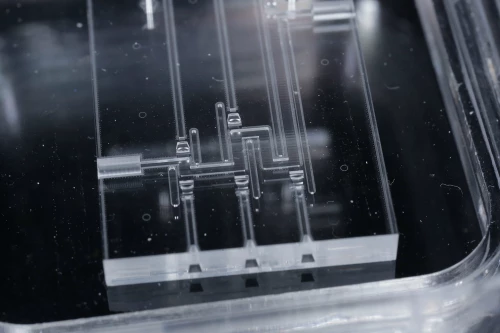
A groundbreaking study recently published in the journal Talanta has shattered previous benchmarks, demonstrating a 3D-printed "Lab-on-a-Chip" that processes thousands of droplets for instantaneous Mass Spectrometry (MS) analysis.
As detailed in the recent industry update from FEMTOPRINT, the core of this innovation lies in shifting from traditional polymer-based microfluidics to monolithic 3D glass structures.
Why CTOs are Prioritizing 3D Glass over PDMS
For years, PDMS (polydimethylsiloxane) was the prototyping standard. However, for scalable, high-performance science, it presents significant risks:
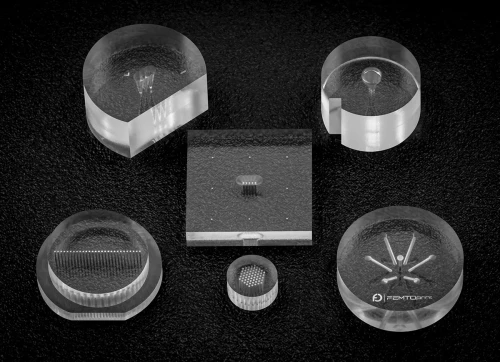
FEMTOPRINT® technology bypasses these hurdles using Femtosecond Laser-Assisted Chemical Etching (FLICE). This "laser-to-glass" process allows for the creation of intricate, chemically inert, and transparent 3D channels directly within a single block of fused silica.
Accelerating the R&D Pipeline
The Talanta study highlights a dramatic shift in operational efficiency:
Unprecedented Speed: Experiments that previously took hours are now performed in seconds thanks to kilohertz-rate droplet processing.
Absolute Precision: The monolithic nature of the glass chip ensures ultra-accurate droplet-based screening with zero leakage or "dead volume".
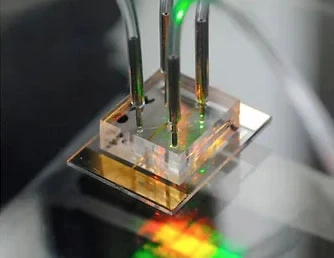
Seamless MS Integration: By printing 3D fluidic interfaces directly in glass, researchers can inject samples into Mass Spectrometers with zero material interference, ensuring maximum signal-to-noise ratios.
What is FEMTOPRINT technology in microfluidics?
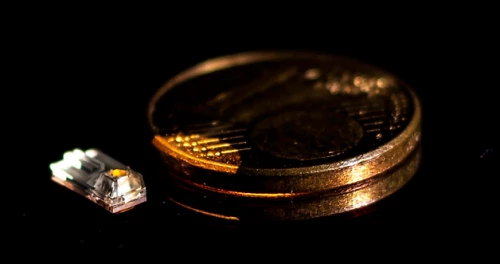
FEMTOPRINT is a unique 3D micromanufacturing platform that uses femtosecond lasers to modify the internal structure of glass. When followed by a chemical etching process, it creates complex, monolithic 3D microstructures with sub-micron precision, ideal for BioMEMS and Lab-on-a-Chip applications.
Why is glass better than plastic for drug discovery chips?
Glass (specifically fused silica) is chemically inert, non-absorbent, and thermally stable. These properties are critical for drug discovery because they prevent reagent loss and ensure that the chemical analysis (such as Mass Spectrometry) reflects the true properties of the drug candidate without background noise from the substrate.
How does 3D printing accelerate High-Throughput Screening (HTS)?
3D printing, particularly through laser-to-glass technology, allows for the dense parallelization of fluidic channels. This enables the simultaneous processing of thousands of picoliter-sized droplets, allowing researchers to screen vast chemical libraries in a fraction of the time required by traditional methods.
Turning Research into Scalable Reality
The collaboration between high-level academic research and industrial-grade technology like that of FEMTOPRINT is turning advanced science into a scalable reality. For CTOs, investing in 3D glass technology isn't just about better data,it’s about reducing the "cost per insight" and bringing life-saving treatments to market faster than ever before.