While effective in many applications, this "metal-first" approach hits a significant wall the moment it enters the MRI suite.
Radiofrequency (RF) heating, mechanical instability, and severe signal distortion are not just engineering inconveniences; they are direct risks to patient safety and barriers to diagnostic clarity.
A 2024 paper in Scientific Reports (Doguet et al.) documents a paradigm shift toward optoelectronic implants that are inherently MRI-compatible. The enabling technology is not simply optical fiber, it is the monolithic glass enclosure that protects the photonics inside the human body.
Why Metal Fails Inside an MRI Scanner
Standard implants with conductive metallic leads behave like antennas inside an MRI bore. At field strengths of 1.5 T and 3 T, oscillating magnetic fields induce currents that create three distinct failure modes:
RF Heating: Induced currents concentrate at the lead tip, causing potential thermal tissue damage.
Signal Artifacts: Metal distorts the local magnetic field, producing "black holes" in images that make diagnosis impossible.
Mechanical Instability: Magnetic forces cause vibration and displacement, creating implant migration risk.
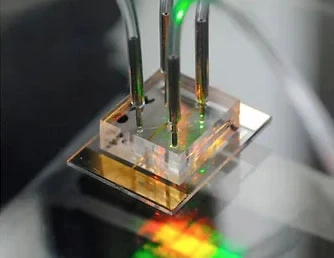
Researchers have addressed this by developing vagus nerve stimulators and neuromodulation devices that use optical fibers instead of copper wires. Light carries both the signal and the power with zero electromagnetic interaction with the scanner's fields.
But this raises a critical question: How do you protect delicate photonic components inside the human body for years or decades?
3D Glass Microfabrication: The Architecture That Makes It Work
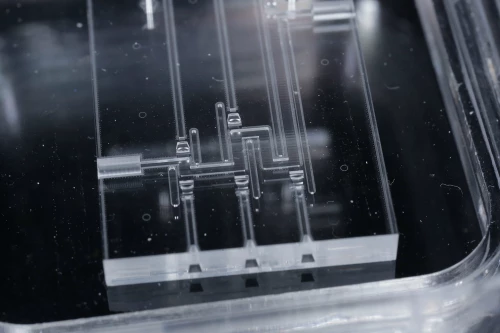
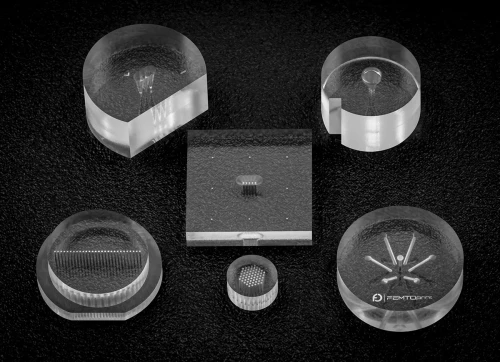
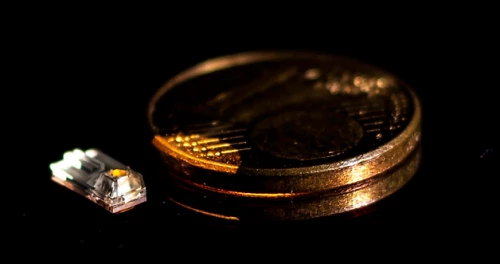
The transition from metal to a monolithic glass architecture is what makes these new microsystems clinically viable. Using advanced 3D laser microfabrication, a core technology developed at FEMTOPRINT, it is now possible to create a single, transparent glass enclosure that integrates every required function.
Embedded Microlenses: High-precision optics integrated directly into the glass casing to focus light onto neural tissue — no external components, no alignment drift.
Internal Microcavities: Sensors and electronics are housed inside sealed cavities machined within the glass body, protected from body fluids without adding bulk.
Sub-Micron Fiber Alignment: Maintaining fiber-to-sensor coupling over years of body movement is one of the hardest problems in implantable photonics. Glass micromachining solves it permanently, with alignment features built into the same monolithic body as the optical path.
Hermetic Sealing: Fused silica is impermeable and biologically inert. True medical-grade protection against body fluids, validated for long-term implantation.
Why Fused Silica Is the Ideal Material for MRI Environments
Not all glass is equal. Fused silica, amorphous silicon dioxide, offers a unique combination of properties that no metal or polymer can match in MRI applications.
It is diamagnetic (no interaction with magnetic fields), RF-transparent (no induced heating), optically clear across a broad spectrum, and chemically inert in biological environments. Its thermal expansion coefficient is among the lowest of any structural material, critical for hermetic joints that must survive decades of thermal cycling inside the body.
This combination is why fused silica is classified as a Class VI biocompatible material and is already used in long-term implantable devices such as intraocular lenses and cochlear implant windows.
From Prototype to Industrial-Scale Production
One of the persistent challenges in implantable photonics has been the "alignment headache": the extreme precision required to couple an optical fiber to a sub-millimeter sensor, and the need to maintain that coupling indefinitely as the implant moves with the body.
Glass microfabrication eliminates this problem at the design level. Alignment features, V-grooves, stop surfaces, locking cavities, are machined into the same monolithic glass body as the optical path itself. There are no separate assembly steps, no adhesives, no metal brackets that could corrode or fatigue.
At FEMTOPRINT, our new headquarters in Agno is purpose-engineered for high-volume, high-precision 3D glass microfabrication from first prototype to regulated production, under a single ISO 13485 quality system.
Which Medical Devices Benefit Most
3D glass microfabrication applies directly to any implantable or near-patient device where one or more of these constraints apply: MRI compatibility is mandatory (cardiac, neural, or orthopedic implants in patients requiring post-operative imaging), long-term hermeticity is required (10+ year implant life), miniaturization is critical (cochlear implants, retinal prostheses, ingestible sensors), optical functionality is needed (photobiomodulation, optogenetics, fiber-optic biosensors), or high alignment sensitivity makes conventional assembly unreliable.
Glass Is Not a Compromise. It's an Upgrade
The metal-and-assembly model has served the implant industry for half a century. But for the next generation of intelligent, chronically implanted devices — particularly those requiring MRI compatibility and optical functionality, it is no longer the best path.
3D glass microfabrication with fused silica offers a single-material solution to three of the hardest problems in implant engineering: electromagnetic safety, long-term hermeticity, and sub-micron optical alignment. The result is a device that is not only safer for patients, but simpler to manufacture at scale.
The shift is already underway. The question is whether your next device program will lead it or follow it.
Are you developing the next generation of MRI-safe devices?
Contact our experts to discover how our 3D glass microfabrication technology can transform your project from concept validation to ISO 13485-compliant production.
Source: Doguet et al. (2024). Scientific Reports, Nature Portfolio.