When an engineering team sets out to develop a new Lab-on-a-Chip (LoC) device, the initial path seems obvious: use polymers. Materials like Polydimethylsiloxane (PDMS), Polymethyl Methacrylate (PMMA), and Cyclic Olefin Copolymer (COC) are cheap to procure, highly accessible, and ideal for churning out rapid prototypes via injection molding or soft lithography.
However, there is a dangerous pitfall in this approach. While polymer microfluidic chips excel in providing quick, low-cost physical models, the real problems hide deep inside the data.
When your high-stakes assay or clinical trial depends on absolute molecular precision, a polymer substrate can quietly alter your results, leading to false negatives, skewed calibration curves, and ultimately, the wrong diagnostic answers.
The Polymer Paradox: 3 Fatal Flaws Hiding in Your Data
Why do polymer chips compromise experimental outcomes? The issues are inherent to the chemical and physical properties of plastics at the micro and nanoscale. Three major mechanisms systematically undermine your data integrity:
Polymers—particularly PDMS—behave like porous molecular sponges. Due to their hydrophobic nature and polymer chain networks, they actively absorb small molecules, therapeutic drugs, hydrophobic analytes, and even lipids from the fluid sample flowing through the channels.
When your test sample passes through a polymer microchannel, active biomolecules migrate into the channel walls instead of reaching the designated reaction or detection zone. This drastically lowers the effective concentration of the analyte, yielding artificially suppressed signals. In diagnostic assays, this results in dangerous false negatives; in drug screening, it completely invalidates pharmacokinetic and efficacy data.
Modern diagnostic assays rely heavily on optical detection, specifically fluorescence microscopy and laser-induced fluorescence, to spot single molecules or ultra-low concentration biomarkers. This is where polymers present a severe physical limitation: autofluorescence.
When excited by optical light sources (such as UV or blue lasers), the native polymer matrix glows. This background fluorescence creates a high level of optical "noise" that obscures the true signal of your fluorescent tags. When working with faint biological signals, the polymer’s background glow can completely blind your sensors, destroying the analytical sensitivity of your device.
Microfluidic applications require precise control over flow kinetics, mixing profiles, and droplet generation, all of which demand stable internal pressures. Because polymers are compliant and elastic, they easily deform and bend under fluidic pressure.
As pressure or flow rate increases, the cross-sectional geometry of a polymer microchannel expands and warps. This alters the hydraulic resistance dynamically, changes the flow velocity profile, and disrupts predictable laminar flow behavior. If your diagnostic test relies on exact volume dosing or precise droplet generation, mechanical deformation completely ruins reproducibility.
The Core Risk: If your chip deforms, absorbs your target analyte, and drowns out your signal with background noise, you are no longer testing your sample—you are testing the erratic physical behavior of your plastic chip.
Glass: The Uncompromising Standard for Analytical Precision
To eliminate these systematic errors, high-precision applications rely on glass. Glass does none of what polymers do. It remains completely unyielding to the chemical and physical demands of micro-scale analysis.
Overcoming the Old Boundary: Femtosecond Laser Microfabrication
If glass is clearly superior, why did the industry ever shift so heavily toward polymers? The answer lies in historical manufacturing limitations. Traditionally, machining glass required harsh chemical etching (like Hydrofluoric Acid etching) or tedious diamond drilling. These processes were strictly restricted to 2D planar geometries, had poor aspect ratios, and required complex, error-prone thermal bonding steps to seal the channels. Designers routinely chose polymers simply because "glass couldn't do" complex 3D shapes.
That limitation is officially dead. Enter Femtosecond Laser Microfabrication.
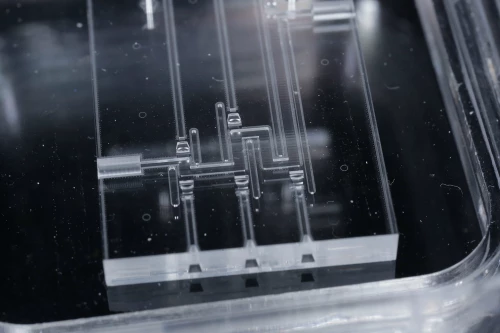
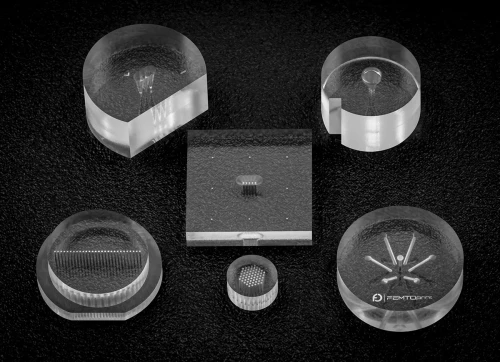
By utilizing ultra-short pulses of laser light focused tightly within the bulk of a glass substrate, a femtosecond laser can modify the material inside the glass block without affecting the outer surface. This localized modification alters the glass structure at a sub-micron scale. When followed by a selective chemical etching process, the modified glass is dissolved away, leaving behind intricate, perfectly smooth 3D microchannels, embedded cavities, and complex structural features.
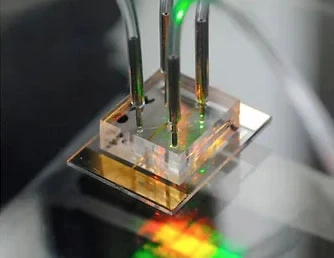
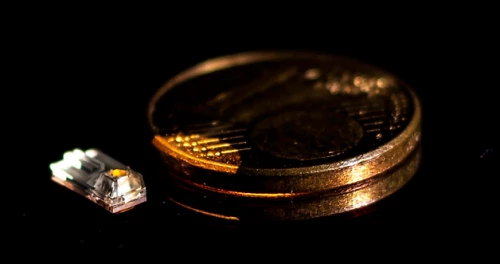
The result is a single, monolithic, solid piece of glass with fully enclosed internal fluidic pathways. There is no bonding interface to leak, no alignment error, and absolutely no structural weakness.
Rethinking Your R&D Pipeline: Is It Time to Shift?
If your development team is still relying solely on polymer microfluidics, it is critical to evaluate whether the perceived savings in prototyping are actually costing you months of delayed timelines due to erratic data anomalies. Shifting from a plastic prototype to a production-ready device often requires completely recalibrating your assays because the material shift completely alters the biochemistry.
By integrating glass microfluidic chips earlier in your R&D lifecycle—leveraging modern 3D laser microfabrication—you bridge the gap between initial prototyping and final commercialization. You ensure that the data you collect during early-stage research is the exact same reliable, clean data that will drive your commercial diagnostic device.
Don't let a cheap material compromise your multi-million dollar clinical breakthrough. Glass can do it now. It’s time to upgrade your data.