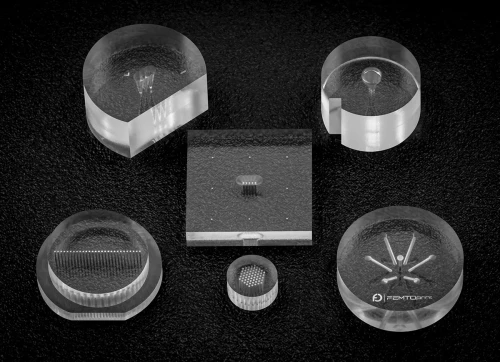
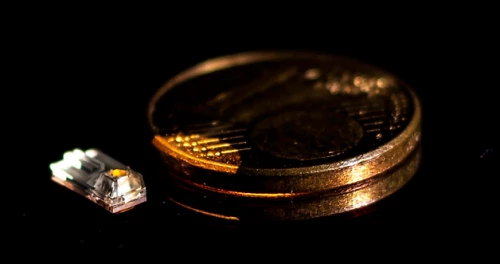
Selective Laser-Induced Etching (SLE) is a microfabrication technique that enables the creation of complex 3D structures inside transparent materials like fused silica or borosilicate glass. It combines ultra-short laser pulses with chemical etching, allowing the user to sculpt highly precise features inside solid substrates — without any lithography, masks, or multi-step processes.
SLE is especially relevant for industries where micron-level precision, optical quality, and material integrity are critical, such as microfluidics, integrated optics, photonics, and MedTech.
How Does SLE Work?
The process behind Selective Laser-Induced Etching involves two main steps:
Laser Modification: A femtosecond laser beam is focused inside the transparent material. The ultrafast pulses induce a localized modification of the glass, changing its chemical structure without damaging the surrounding volume.
Chemical Etching: The sample is then exposed to a chemical etchant (typically HF or KOH), which selectively removes only the laser-modified regions, leaving the unmodified glass intact.
The result?
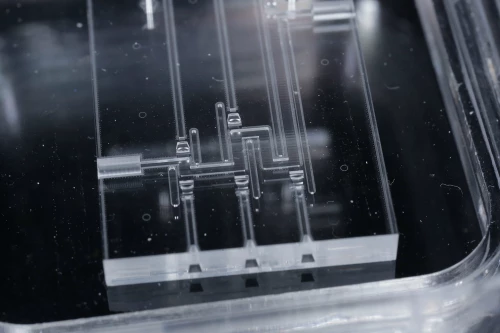
Highly controlled 3D structures, such as channels, voids, or even internal cavities — all created within the glass substrate.
Advantages of Selective Laser-Induced Etching
Compared to traditional fabrication methods (like lithography or mechanical drilling), SLE offers several key benefits:
Applications of SLE Technology
Selective Laser-Induced Etching is enabling new possibilities in advanced R&D and industrial applications, including:
Microfluidics & Lab-on-Chip Devices
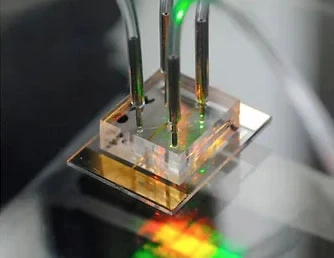
Design complex internal channel networks for chemical or biological analysis, directly inside glass substrates.
Integrated Optics-Photonics & Quantum
Embed waveguides, beam splitters, or microlenses inside fused silica chips — ideal for miniaturized optical systems.
Create micro-reservoirs or fluidic systems in biocompatible glass for diagnostics, drug delivery, or biosensing.
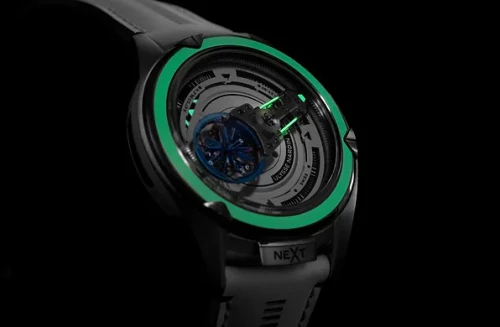
Engrave invisible serials, internal microstructures, or fluidic complications inside sapphire or borosilicate components.
Why Choose FEMTOPRINT for SLE Technology?
We specialise in high-precision femtosecond laser fabrication, including Selective Laser-Induced Etching for both research and industrial clients.
Whether you're developing next-gen photonic devices or building a microfluidic prototype, our SLE capabilities can dramatically reduce your time-to-functional-part.
If you're looking for a reliable partner in Selective Laser-Induced Etching (SLE), with real experience and flexible R&D support, let’s talk.