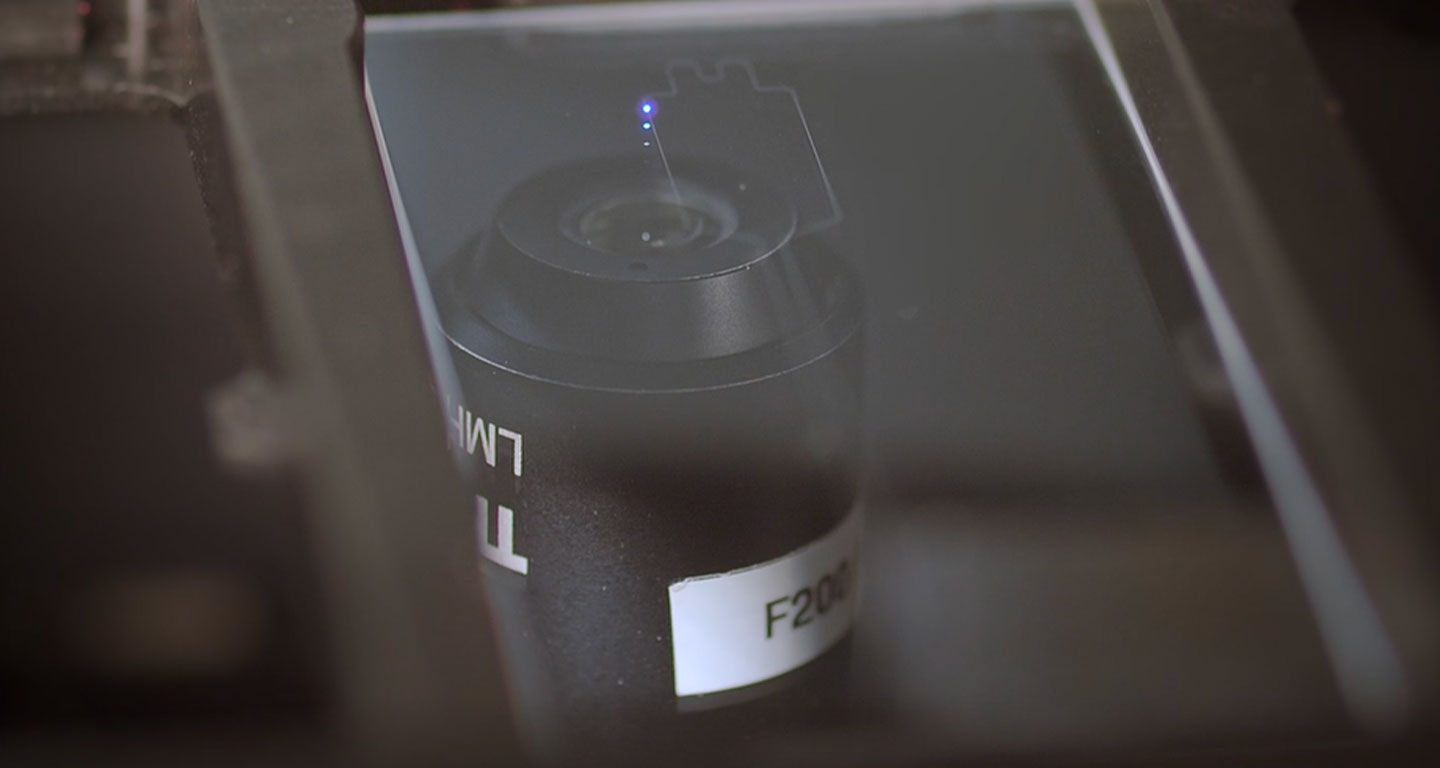
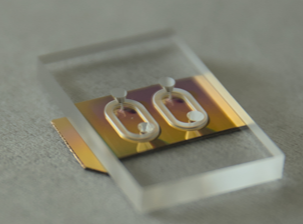
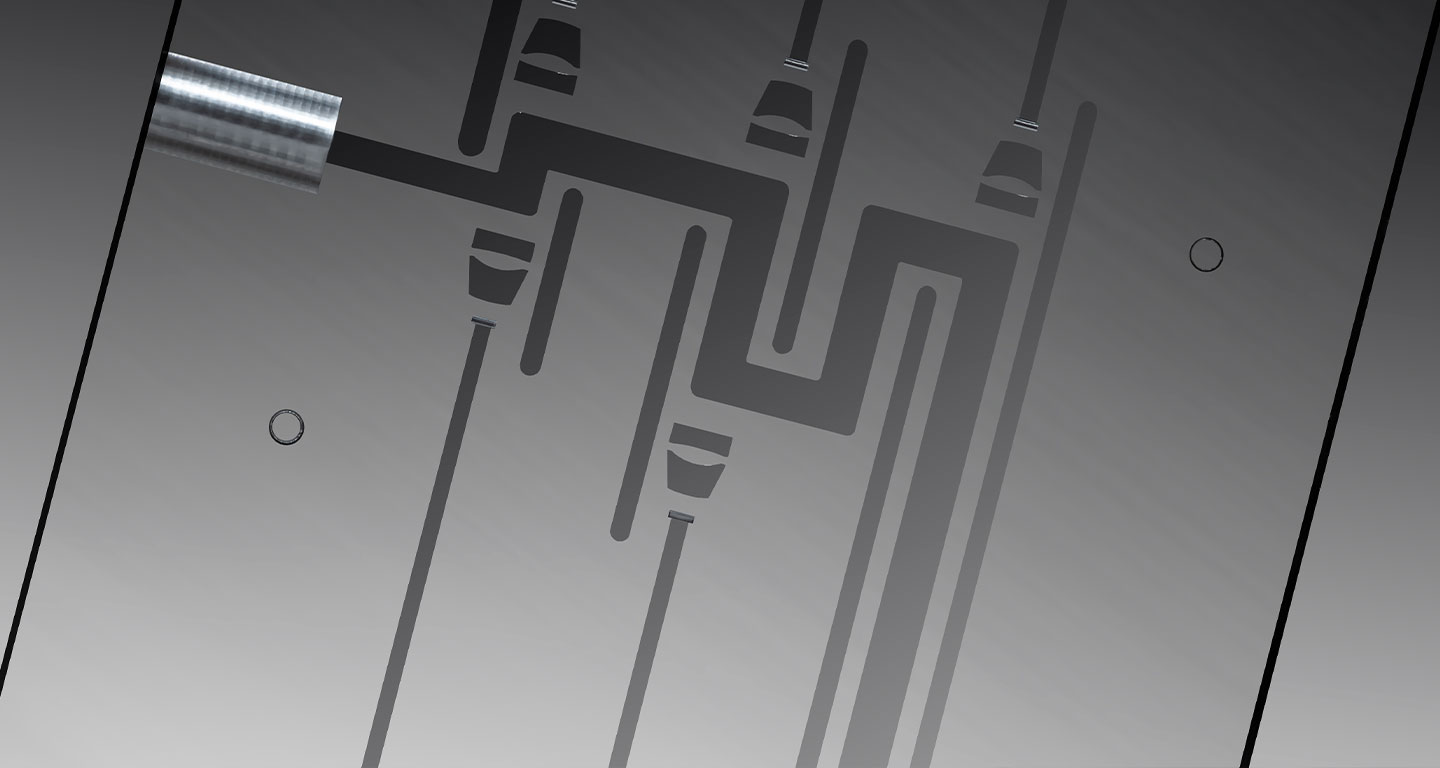
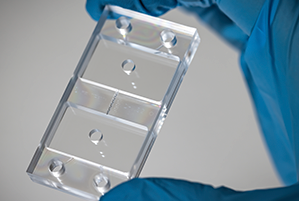
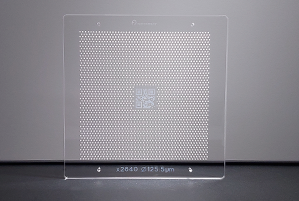
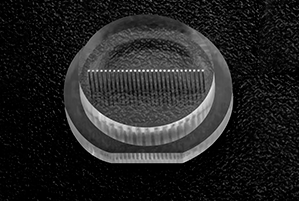
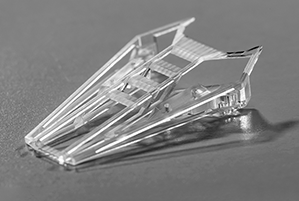
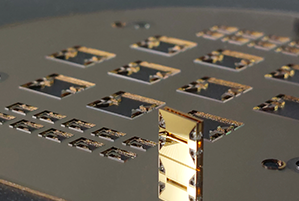
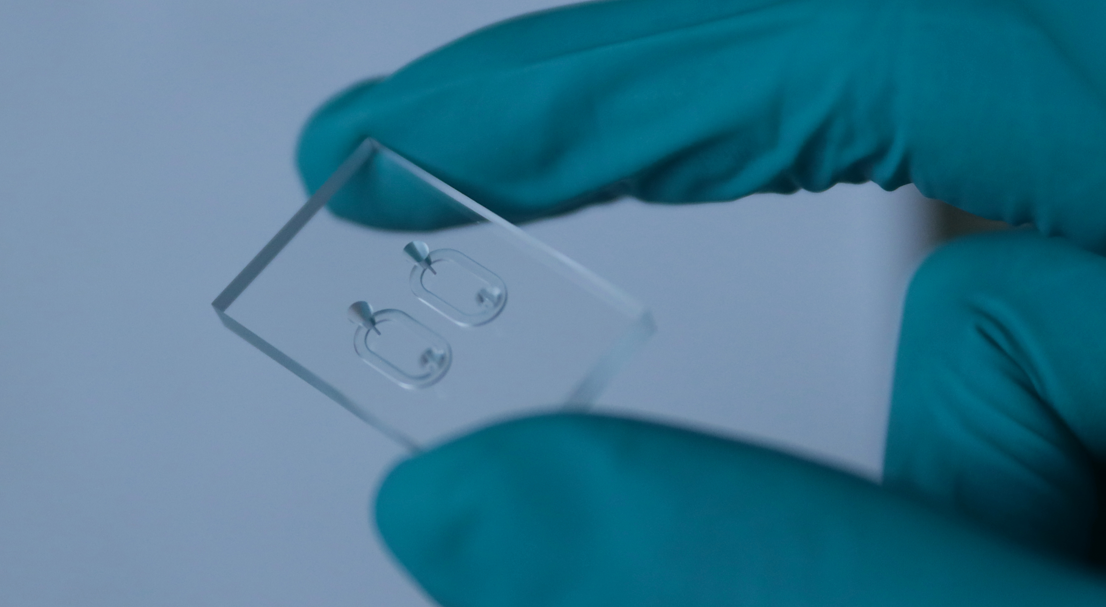
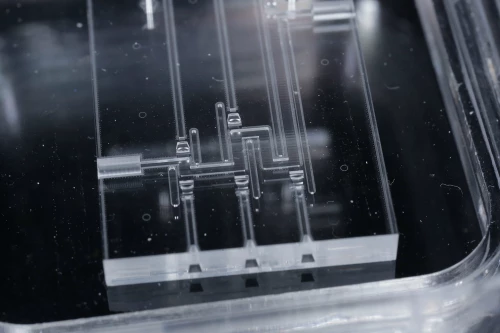
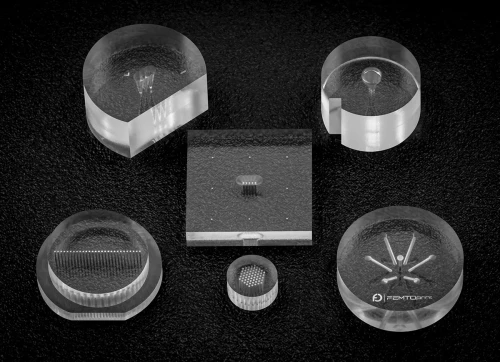
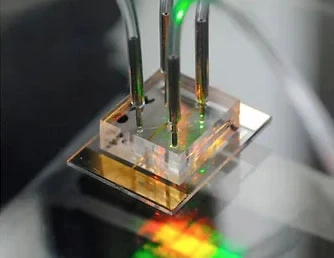
Instead of bonding separate components, the interposer carries waveguides, alignment features, and fiber-coupling structures inside a single piece of glass.
Co-packaged optics moves the optical engine next to the switch ASIC to cut power loss and free up board space. That move only works if the interconnect between fiber, interposer, and chip holds sub-micron alignment across thousands of channels, run after run. Mechanical assembly of discrete parts struggles to do that at volume. FEMTOPRINT manufactures glass interposers using Selective Laser Etching (SLE), a femtosecond-laser process that writes waveguides and etches alignment features inside the glass in the same production flow, removing one source of assembly error.
AI datacenter traffic is pushing optical I/O density past what discrete fiber arrays and separate alignment hardware can support cost-effectively. Three constraints define the problem an interposer has to solve:
Monolithic fabrication addresses all three at once: waveguides, fiber alignment ferrules and micro-optical elements are written into one substrate rather than assembled from parts.
FEMTOPRINT glass interposers combine monolithic waveguides, fiber-alignment structures, and micro-optics in fused silica or borosilicate glass, fabricated at wafer scale up to 300 mm with XY alignment tolerance of ±1 µm and Z tolerance of ±2 µm, built to meet the channel density and loss budgets of CPO architectures.
FEMTOPRINT fabricates interposers using 3D glass waveguide writing combined with selective etching for fiber-alignment features. The same SLE platform that writes the optical path also etches the mechanical structures around it, so the waveguide and its alignment reference are positioned by the same laser system in the same coordinate frame — not bonded together afterward.
An interposer rarely works alone. It sits between the fiber array and the photonic die, and is typically specified alongside glass fiber ferrules for fiber termination and micro-optical components for beam shaping or splitting. Engineers building a full transceiver or CPO module typically need all three specified as one assembly, which is why FEMTOPRINT designs them as a coherent platform rather than three separate product lines.
Most CPO programs start with a small batch of interposers for optical validation, then scale to production volume once the design is locked. FEMTOPRINT supports both stages on the same wafer-scale process, so design changes between prototype and production do not require a new tooling cycle. See contract development and manufacturing services for the full path from feasibility to ISO 13485-certified volume production.
Talk to our photonics engineering team about your CPO interposer specification to start your project.
A glass interposer is a monolithic glass substrate that routes optical signals and in some designs electrical signals, between a photonic chip and its fiber connections. It replaces several discrete alignment components with one fabricated piece, reducing the number of interfaces where light can be lost or misaligned.
In CPO architectures, the glass interposer sits between the optical fiber array and the photonic integrated circuit, providing precise, repeatable alignment for high-channel-count interconnects used in AI datacenter switches and optical transceivers.
FEMTOPRINT manufactures glass interposers with XY alignment tolerance of ±1 µm and Z tolerance of ±2 µm, with a minimum feature size below 5 µm, fabricated at wafer scale up to 300 mm.
Verified waveguide propagation loss is 0.25 dB/cm. Coupling loss is 0.15 dB per facet, with crosstalk below –30 dB at 20 µm pitch, characterized at 1310 nm. Figures outside these tested ranges are defined per application and require a feasibility review.
Glass holds its refractive index and physical geometry across temperature swings that affect polymer- and epoxy-based alignment. It also allows true 3D waveguide routing inside the substrate, not just on its surface, which silicon interposers cannot do without added bonding steps.
Yes. FEMTOPRINT fabricates glass interposers at wafer scale up to 300 mm under ISO 13485:2016 and ISO 9001:2015 certification, supporting the transition from prototype validation to certified volume production on the same process.