The photonics industry is at a pivotal moment. As demand for high-speed optical interconnects, advanced sensing, and optical computing explodes, the ability to move rapidly from prototype to mass production has become the decisive competitive factor for CTOs and technology leaders.
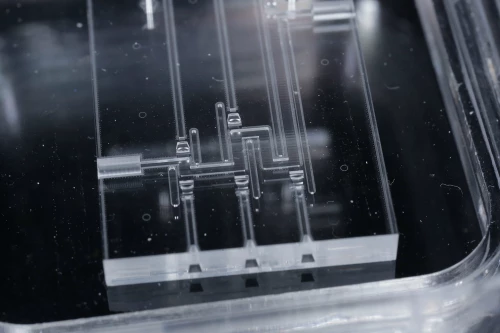
FEMTOPRINT SA is addressing this exact challenge with its proprietary ultrafast laser-based 3D glass microfabrication platform. We will be presenting at the Optica Global Advanced Manufacturing Alliance 2026 in Brussels on June 2, 2026.
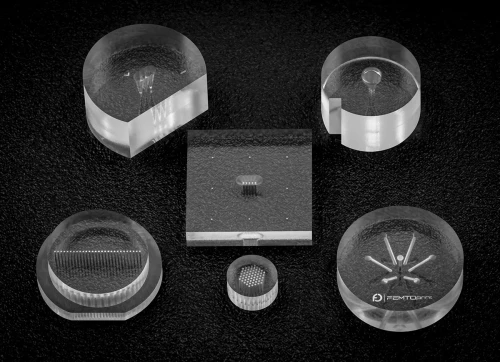
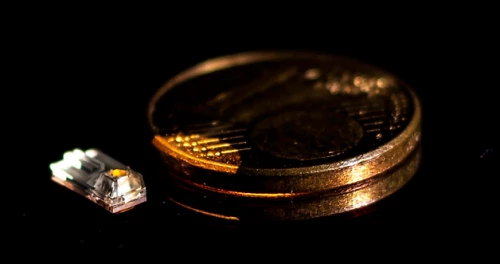
Traditional photonics manufacturing often forces painful compromises between precision, design freedom, and scalability. FEMTOPRINT’s technology removes many of these constraints by enabling true 3D structuring of high-quality glass (including fused silica) with micron resolution.
This approach delivers:
Key Applications Driving Industry Interest
|
Industry |
Critical Need |
FEMTOPRINT Advantage |
|
AI & Optical Computing |
Ultra-dense, low-power optical interconnects |
3D waveguides and integrated coupling structures |
|
Datacom |
High-performance, detachable fiber connections |
Low-loss, scalable detachable connectors |
|
Advanced Sensing |
Miniaturized, robust optical components |
Complex 3D monolithic glass structures |
|
MedTech |
Biocompatible, high-precision micro-optics |
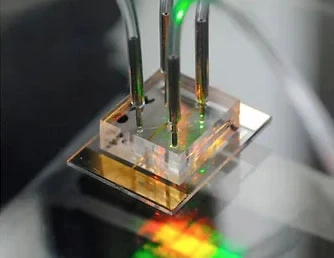
Glass microfluidic and optical medical devices |
Featured Panel: “Detachable Low-Loss Fiber Connectors”
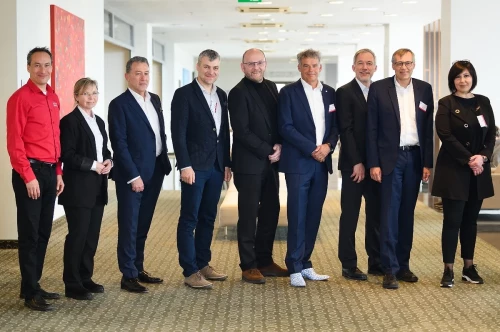
On June 2, 2026, Rolando Ferrini, Chief Product Officer at FEMTOPRINT SA, will join a select panel of experts to discuss one of the most pressing topics in photonics packaging:
“Detachable Low-Loss Fiber Connectors”
Expect technical depth on:
What makes ultrafast laser 3D glass microfabrication different from conventional lithography or etching?
It is a true additive, maskless, direct-write process that creates complex 3D geometries inside bulk glass in a single step. This eliminates multiple process layers, reduces alignment errors, and enables structures impossible with planar techniques.
How does this technology support the transition from lab prototypes to volume manufacturing?
The same core process is used from rapid prototyping through to production. This dramatically reduces qualification time and risk when scaling, allowing companies to maintain performance consistency across thousands to millions of units.
What performance level can be expected for detachable fiber connectors?
FEMTOPRINT focuses on ultra-low-loss designs suitable for next-generation datacom and AI optical interconnects, where every 0.1 dB improvement translates into significant system-level power and cost savings.
Which materials are compatible?
Primarily high-optical-quality glasses such as fused silica, but also other technical glasses depending on application requirements (thermal, mechanical, or optical properties).
Strategic Takeaway
In 2026, photonics is no longer just about innovation in the lab, it’s about who can manufacture at scale with precision and speed. FEMTOPRINT’s ultrafast laser 3D glass microfabrication platform positions early adopters to turn optical innovation into real product advantage.
Whether you are developing next-generation optical compute engines, high-bandwidth data center solutions, or advanced medical devices, this technology offers a powerful bridge between visionary design and industrial execution.
Join FEMTOPRINT at the Optica Global Advanced Manufacturing Alliance 2026 in Brussels on June 2.
Interested in exploring how 3D glass microfabrication can accelerate your photonics roadmap?
Contact the FEMTOPRINT team directly or schedule a meeting during the event.
See you in Brussels.