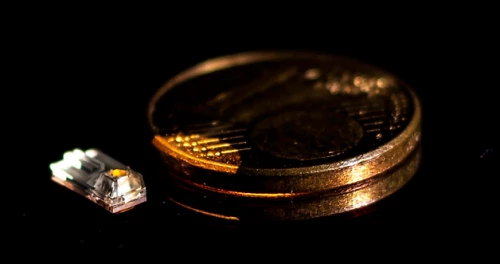
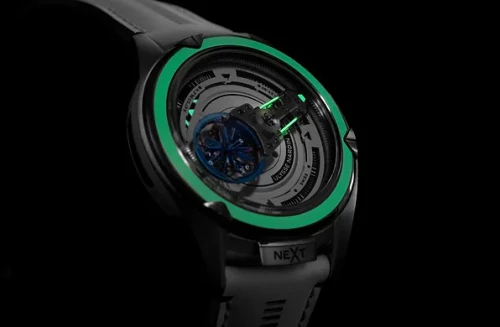
When mission success depends on components operating millions of miles from Earth, every gram of weight, every micron of tolerance, and every material interface becomes a potential point of failure. At FEMTOPRINT SA, we are redefining the limits of aerospace engineering through ultrafast femtosecond laser glass microfabrication.
The Monolithic Advantage: Solving the "Outgassing" Crisis
Traditional micro-assembly relies on adhesives, wire bonds, and multi-material stacks. In deep-space environments, these are liabilities. Adhesives can "outgas," releasing volatile compounds that contaminate sensitive telescope optics or sensor arrays. Thermal expansion mismatches between different materials lead to structural fatigue under the extreme cycling of -150 °C to +150°C.
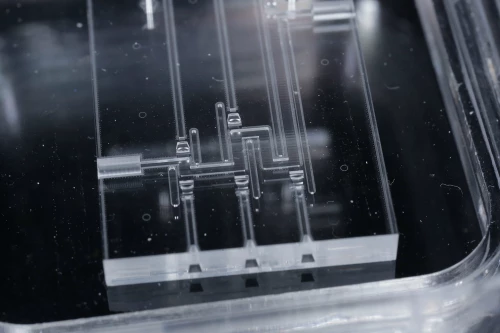
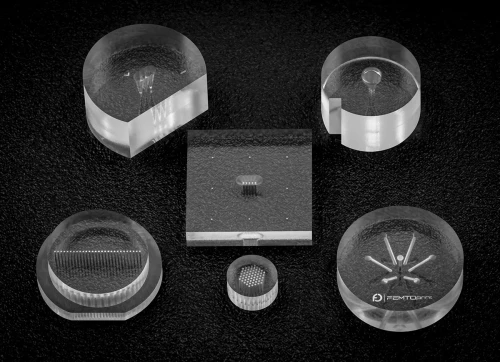
The FEMTOPRINT® Solution: By using monolithic 3D glass microdevices made of radiation-hard fused silica, we eliminate the need for glues and mechanical fasteners.
The result is a single, continuous piece of glass with sub-micron accuracy that is inherently stable, chemically inert, and vacuum-compatible.
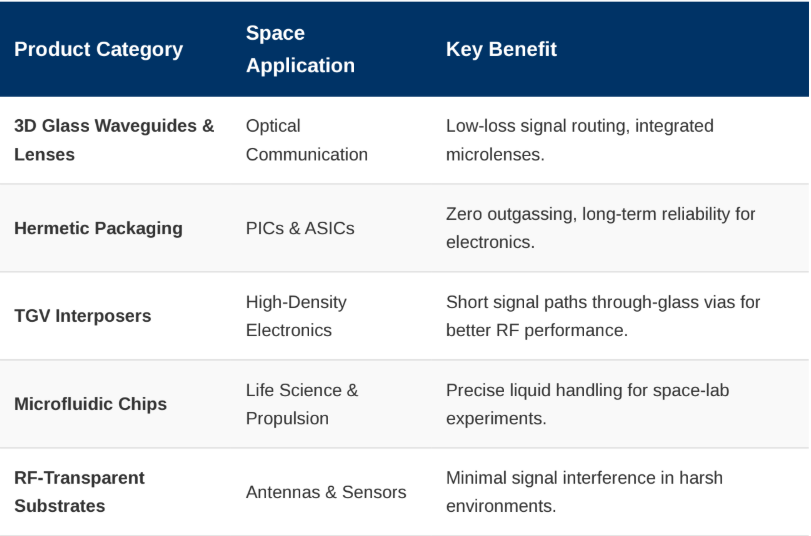
Comprehensive Solutions for Modern Satellites
Our technology addresses the industry’s most pressing challenge: SWaP reduction (Size, Weight, and Power). By integrating multiple functions into a single glass substrate, we reduce the footprint of complex instrumentation.
Thermal Resilience: From Lunar Night to Solar Noon
Spacecraft components must endure rapid thermal transitions. Fused silica is the gold standard for these conditions due to its exceptionally low coefficient of thermal expansion (CTE). Our monolithic designs handle temperatures from -150 °C to +150 °C inherently, without the risk of delamination or structural warping that plagues hybrid assemblies.
How does femtosecond laser microfabrication improve satellite components?
It allows for sub-micron precision in 3D glass structures, enabling the creation of monolithic devices that eliminate adhesives, reduce weight, and prevent outgassing
in vacuum environments.
What are the benefits of using fused silica in deep space?
Fused silica is radiation-hard, RF-transparent, and maintains structural integrity
across extreme temperatures (-150°C to +150°C), making it ideal for telescopes and deep-space probes.
Can glass microfabrication help with SWaP reduction?
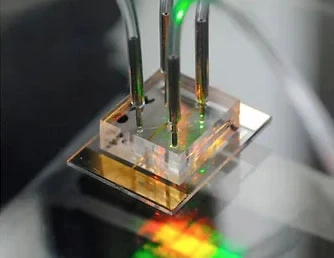
Yes. By integrating optical waveguides, electrical vias (TGV), and mechanical housings into a single monolithic glass chip, engineers can significantly reduce the
size and weight of instrumentation.
Why is "no outgassing" important for space optics?
Outgassing from glues or plastics can create a film on lenses and sensors, degrading the performance of telescopes and scientific instruments. Monolithic glass
solutions remove this risk entirely.