Every procurement lead and supply chain director faces the same fundamental challenge: identifying a manufacturing partner capable of delivering sub-micron precision at high volumes. Achieving tight tolerances during pilot runs or single prototypes is routine; sustaining those exact specifications across thousands of production units without batch drift or material degradation, is remarkably rare.
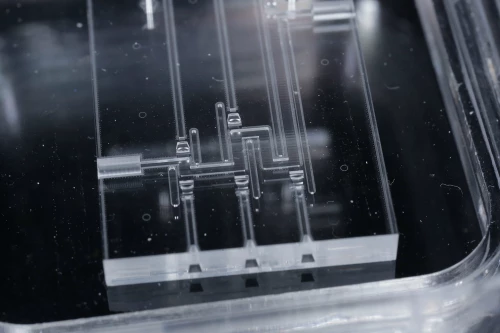
In macro-scale manufacturing, tolerance stacks and generous design margins often absorb process variability. In contrast, glass microfabrication operates under uncompromising physical constraints. A drift of just 1 μm in microfluidic channels, optical waveguides, or glass MEMS components is not a statistical rounding error.
It represents an immediate device failure.
What Procurement Leaders Actually Need (The 4 Non-Negotiables)
When qualifying a contract development and manufacturing organization (CDMO) for mission-critical glass components, technical and procurement teams must evaluate four non-negotiable criteria:
Why Conventional Micromachining Fails at Scale vs. The FEMTOPRINT Advantage
Traditional glass processing methods—such as CNC diamond grinding, dicing, ultrasonic drilling, or lithographic wet etching—rely on mechanical friction or multi-step masking. As production volume increases, mechanical tools wear, chemical baths age, and lithographic masks require multi-axis realignments, causing cumulative stack-up errors.
To compensate, conventional shops typically force procurement leads into two unpleasant choices:
The Physics of Selective Laser Etching (SLE) at FEMTOPRINT
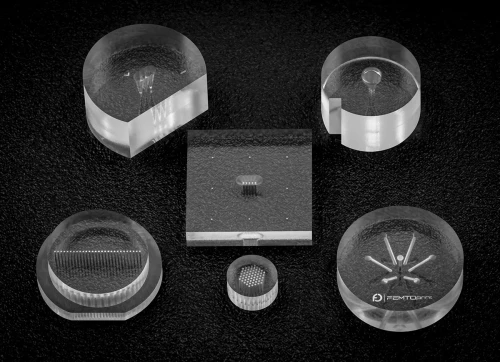
FEMTOPRINT overcomes these traditional tradeoffs by using femtosecond laser-based Selective Laser Etching (SLE). Ultrafast laser pulses modify glass material locally in 3D space without mechanical contact or thermal stress. Because material removal is directly governed by precise laser pulse energy and spatial positioning, scaling production does not introduce mechanical tool wear or thermal drift.
With FEMTOPRINT technology, scaling throughput is simply a function of laser power utilization. The exact laser parameters that hold a ±1 μm tolerance on prototype unit #1 will hold the identical ±1 μm tolerance on unit #10,000, maintaining consistent surface roughness (Ra < 10 nm when specified).
Vertical Integration: Mitigating Supply Chain Risk
Outsourcing individual steps (such as substrate procurement, laser machining, chemical polishing, or metrology) creates hidden supply chain vulnerabilities. When defect issues occur at an external vendor, root-cause analyses stall, timelines slip by months, and liability becomes fragmented.
FEMTOPRINT eliminates these risks through complete internal vertical integration:
The CDMO Qualification Checklist for Procurement & Engineering
Before committing a microfabrication partner to your supply chain, evaluate them against these critical criteria:
Q1: does FEMTOPRINT maintain ±1 μm tolerances at high production volumes?
FEMTOPRINT uses Selective Laser Etching (SLE), a non-contact femtosecond laser process. Because there is no physical mechanical contact or tool wear, process parameters remain completely stable across single units or runs of 10,000+ parts.
Q2: Why is ISO 13485 certification essential for glass microfabrication CDMOs?
ISO 13485 dictates strict design control, risk management, cleanroom processing, and total batch traceability required for regulated medical devices, microfluidic diagnostic chips, and surgical micro-optics.
Q3: What glass substrates can FEMTOPRINT process?
FEMTOPRINT routinely processes high-purity fused silica, borosilicate, ultra-low expansion glass (ULE®), and custom optical glasses suited for photonics, quantum computing, and biomedical devices.
Do you need a reliable partner for your project?
Related capabilities: Learn more about our Design for Manufacturing (DFM) approach and our Glass Microfabrication process.